Whether you’re an owner contemplating expansion, a restaurateur seeking capital, or someone eyeing the hospitality industry as your next venture, understanding the investment landscape is your first course. And trust me, it’s more complex than your most elaborate tasting menu. Let’s break down everything you need to know about putting your money where your menu is.
Restaurant investing offers returns despite risks and challenges
Let’s address the elephant in the dining room: restaurants are notoriously risky. So why do smart money people keep coming back to this industry like regulars to their favorite booth?
Because when restaurants work, they really work. There’s tangible satisfaction in building something people experience with all five senses. Unlike investing in, say, software or manufacturing, you can actually walk into your investment, taste the product, and watch customers’ faces light up. That emotional connection? It’s powerful, and it keeps investors hooked even when spreadsheets suggest they should run.
Restaurants also offer diversification beyond traditional stocks and bonds. You’re investing in real assets, equipment, inventory, intellectual property (recipes, branding), and human capital. Plus, the industry’s resilience is remarkable. People always need to eat, and the desire for experiences over stuff isn’t going anywhere.
There’s also the scalability factor. A successful single location can spawn multiple outlets, franchise opportunities, or even product lines. That neighborhood taco spot could become a regional chain, then a national brand. The upside potential, while not guaranteed, is real.
Margins are 3-9% with ROI in 3-5 years
Let’s talk numbers, because romance aside, you’re here to make money.
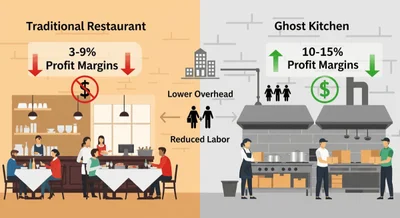
Restaurant profit margins vary wildly by concept. Full-service establishments typically see net profit margins of 3-5%(yes, really), while quick-service concepts might hit 6-9%. Seems slim, right? But remember, that’s net. The gross margins on food can range from 60-70%, and beverage, especially alcohol, can soar above 80%.
Successful restaurants often generate strong cash flow even with modest margins. A well-run establishment doing $2 million in annual revenue at 5% net profit still puts $100,000 in your pocket, not counting potential real estate appreciation if you own the building.
The real magic happens with multiple locations. Economies of scale kick in: centralized purchasing, shared marketing costs, streamlined operations. Chains with 3+ locations often see margins improve by 2-3 percentage points.
ROI timelines vary, but investors typically look for payback periods of 3-5 years. Fast-casual concepts with lower buildout costs might recoup investment faster, while upscale dining with hefty construction bills takes longer.
But here’s what spreadsheets don’t capture: brand equity. A restaurant that becomes a community staple, a destination, a name people recognize—that intangible value can multiply your exit valuation when it’s time to sell.
Evaluate opportunities through financial and location analysis
So you’ve found a potential investment that’s caught your eye. Maybe it’s a chef with an incredible concept, or an existing restaurant that’s on the market. Before you sign anything or transfer funds, you need to do your homework, and not just the Cliff Notes version.
Due diligence in restaurant investing isn’t optional. It’s the difference between building wealth and funding someone else’s expensive education.
Review 3 years of statements
First things first: follow the money. Not just where it goes, but where it’s been and where it’s headed.
Request at least three years of financial statements, profit and loss, balance sheets, cash flow statements. If it’s a new venture, demand detailed projections with assumptions you can actually verify. And don’t just glance at the bottom line: dig into the details.
Look at revenue trends. Is growth steady, seasonal, or erratic? Compare month-over-month and year-over-year. Seasonal businesses need cash reserves to survive slow periods—is that factored in?
Examine expense ratios. Industry benchmarks suggest food costs should be 28-35% of revenue, labor 25-35%, and occupancy (rent/mortgage) under 10%. If numbers are wildly off, ask why. Maybe there’s a brilliant reason… or maybe there’s terrible management.
Scrutinize debt obligations. What loans exist? What are the terms? Is debt serviceable with current cash flow, or are they juggling credit cards and crossing fingers?
Check the tax returns (because P&L statements can be… creative). Compare reported income to what banks and investors are seeing. Discrepancies are red flags waving frantically.
Review vendor relationships and payables. Are they current with suppliers, or is there a trail of late payments and strained relationships? Food vendors talk—if your restaurant gets a reputation for slow payment, you’ll lose preferential pricing and terms.
Don’t forget inventory turnover. Restaurants should turn inventory 4-8 times monthly depending on concept. Slow turnover means waste, spoilage, and tied-up capital.
Check demographics and competition
Real estate people say it, and it’s equally true for restaurants: location, location, location.
But location isn’t just about foot traffic (though that helps). It’s about fit between concept and community.
Start with demographic analysis. Who lives and works nearby? What’s their income level? Age range? Lifestyle preferences? A farm-to-table concept might thrive in an affluent, health-conscious suburb but struggle in a college town where students want cheap calories.
Assess competition. Who else is nearby, and how are they doing? Too much competition is obvious trouble, but zero competition might mean there’s no demand. Look for a market with appetite (pun intended) but room for your specific offering.
Evaluate accessibility and visibility. Can people see your location? Is parking adequate? Is it near complementary businesses (movie theaters, shopping, offices) that drive traffic?
Consider the trade area. Fast-casual concepts draw from 1-3 miles; fine dining might pull from 10+ miles. Is your customer base within realistic reach?
Research future development plans. Is the area growing or declining? Are there planned infrastructure changes? New residential developments mean opportunity; planned highway construction means disaster.
Check lease terms carefully if you don’t own the real estate. What’s the length? Renewal options? Rent increases? Can you transfer the lease? Terrible lease terms have killed more restaurants than bad food.
Finally, visit at different times—morning, lunch, evening, weekend. Does the area have life when you need it? That prime corner location might be perfect for lunch but dead after 5 PM if you’re planning a dinner concept.
Restaurant financing requires multiple sources and creativity
Let’s talk about funding, because great ideas need capital to become reality.
Restaurant financing is its own beast. Traditional banks see restaurants as high-risk (they’re not wrong), so you’ll need creativity, persistence, and probably multiple funding sources.
Personal capital often forms the foundation. Most investors commit 20-30% of total costs from their own pockets. This shows lenders you have skin in the game and aren’t treating their money like a roulette bet. Plus, the more you self-fund, the less equity you surrender or interest you pay.
SBA loans (Small Business Administration) are popular for good reason. The 7(a) and 504 programs offer reasonable rates and terms. You’ll still need good credit, a solid business plan, and that personal investment, but SBA backing makes banks more willing to say yes. Expect a process that takes 60-90 days minimum—start early.
Commercial bank loans are possible if you have strong financials, collateral, and banking relationships. Banks prefer lending to existing, profitable restaurants over startups. If you’re expanding rather than launching, this path opens up considerably.
Equipment financing lets you purchase kitchen gear, furniture, and technology with the equipment itself as collateral. Terms typically run 3-7 years with reasonable rates, and it preserves working capital for operations.
Investors and partners bring capital in exchange for equity or profit-sharing. This dilutes ownership but provides funds without debt payments. Choose partners carefully—you’re marrying these people (sort of). Align on vision, involvement level, and exit strategies upfront.
Crowdfunding has emerged as a viable option, especially for concepts with compelling stories or community support. Platforms like Kickstarter or restaurant-specific sites let you raise funds from future customers. The process builds marketing buzz, but success requires significant promotional effort.
Vendor financing for inventory and equipment is sometimes available from suppliers eager for your business. Terms are usually short, but it can bridge gaps.
Eight steps guide you from consideration to grand opening
Ready to actually do this thing? Here’s your roadmap from consideration to grand opening (or acquisition).
Step one: Get crystal clear on your role and goals. Are you an active operator or passive investor? What return do you need, and by when? What’s your risk tolerance, really? Write this down. You’ll reference it when emotions run high.
Step two: Build or join your team. Unless you’re a restaurant veteran with legal and accounting chops, you’ll need advisors. Find a restaurant-savvy attorney, accountant, and possibly a consultant or experienced operator. Their fees are tiny compared to the mistakes they’ll help you avoid.
Step three: Identify opportunities. Scour restaurant-for-sale listings, network within the industry, talk to commercial real estate brokers, or develop your own concept with an operator. Cast a wide net initially; narrow based on your criteria.
Step four: Conduct thorough due diligence (see earlier section). Don’t skip steps. Don’t let excitement override caution. If something feels off, it probably is—keep digging or walk away.
Step five: Structure the deal. Will you buy assets or equity? What’s the purchase price and payment terms? How will ownership and decision-making work? What happens if targets aren’t met, or if someone wants out? Get everything in writing, reviewed by your attorney.
Step six: Secure financing. Apply for loans, finalize investor commitments, and ensure funds will be available when needed. Build in buffer time—financing always takes longer than promised.
Step seven: Close and launch. Transfer ownership, obtain necessary licenses, hire or transition staff, and open doors. Plan for a ramp-up period where operations and revenue build gradually.
Step eight: Monitor and adjust. Track key metrics weekly: revenue, food cost percentage, labor percentage, customer counts, average check size. Compare actuals to projections. When gaps appear (they will), diagnose quickly and adjust.
Pro tips:
- Visit the restaurant (if existing) repeatedly as a customer before buying. Observe everything.
- Talk to current employees if possible—they know where bodies are buried.
- Negotiate an earn-out or seller financing if buying existing; keeps sellers motivated during transition.
- Plan your grand opening or relaunch carefully. First impressions matter enormously in restaurants.
- Build relationships with local media, food bloggers, and influencers early.
- Don’t cheap out on point-of-sale systems and accounting software—good data drives good decisions.
Success requires informed decisions and realistic expectations
If you’ve read this far, you’re probably serious about this opportunity. Good. The industry needs more informed investorswho view restaurants as businesses first, passion projects second. Who understand that success takes time, money, expertise, and a healthy dose of luck.
Your next steps? Keep learning. Visit restaurants, not as a customer, but as a student of operations. Talk to owners, ask questions, and read financials until you can spot red flags instantly. Build your advisory team. And when you find the right opportunity—not the exciting one, the right one—proceed with commitment and realistic expectations.
Frequently Asked Questions
What are the main types of restaurant investments available?
Restaurant investments include full ownership, partnership or co-ownership, franchise investment, passive investment as a silent partner, and real estate investment where you lease property to operators. Entry costs range from $50,000 for minority stakes to $500,000+ for full-ownership establishments.
Why do so many restaurant investments fail?
Approximately 60% of restaurants fail within three years due to high operational complexity, thin profit margins, market volatility, changing consumer preferences, location dependency, labor challenges, and unpredictable food costs. Insufficient working capital is another common cause.
What should I look for during restaurant investment due diligence?
Examine at least three years of financial statements, verify expense ratios meet industry benchmarks (food costs 28-35%, labor 25-35%), review debt obligations, check tax returns, assess vendor relationships, analyze location demographics, evaluate competition, and inspect lease terms carefully.
Can I invest in a restaurant without being involved in daily operations?
Yes, passive investment allows you to provide capital while operators handle daily management. You act as a silent partner, and your returns depend on the operator’s expertise. This approach offers less hands-on involvement but requires careful selection of experienced partners.