You’ve heard the buzz: ghost kitchens are the future of food service. No dining room, no servers, just your kitchen and delivery orders. Sounds like a dream, right? But are ghost kitchens actually profitable?
The short answer? They can be. But it’s not as simple as launching a menu and waiting for cash to roll in. Ghost kitchens promise lower overhead and better margins than traditional restaurants, but they come with their own challenges: delivery fees that eat into revenue, fierce competition, and marketing costs that can spiral quickly.
If you’re considering converting existing space into a ghost kitchen or launching a delivery-only brand, you need the real deal. Not the hype. Just the numbers, strategies, and honest truth about what makes these kitchens tick… or sink.
Ghost kitchens are delivery-only facilities: here’s how they work
A ghost kitchen, also called a cloud kitchen, dark kitchen, or virtual kitchen, is a food preparation facility designed exclusively for delivery and takeout orders. No walk-in customers. No ambiance to maintain. No waitstaff juggling six tables at once. It’s essentially the backend of a restaurant without the front.
Here’s how it typically works: You set up shop in a commercial kitchen space (which might be shared with other brands or fully yours), create a delivery-only menu, and partner with third-party platforms like Uber Eats, DoorDash, or Grubhub to reach customers. Some operators run multiple virtual brands out of the same kitchen—think a burger joint, a wing spot, and a pasta concept all cooking side-by-side in one space. It’s like running three restaurants with one kitchen and one team.
The beauty of this model? You’re not paying for prime real estate with foot traffic. You’re not renovating a dining room or worrying about whether your décor is Instagram-worthy. You focus purely on what comes out of the kitchen and how fast it gets to the customer’s door. For many restaurant owners, it’s a way to test new concepts without the soul-crushing investment of opening a brick-and-mortar location.
Ghost kitchen profit margins vs. traditional restaurants explained
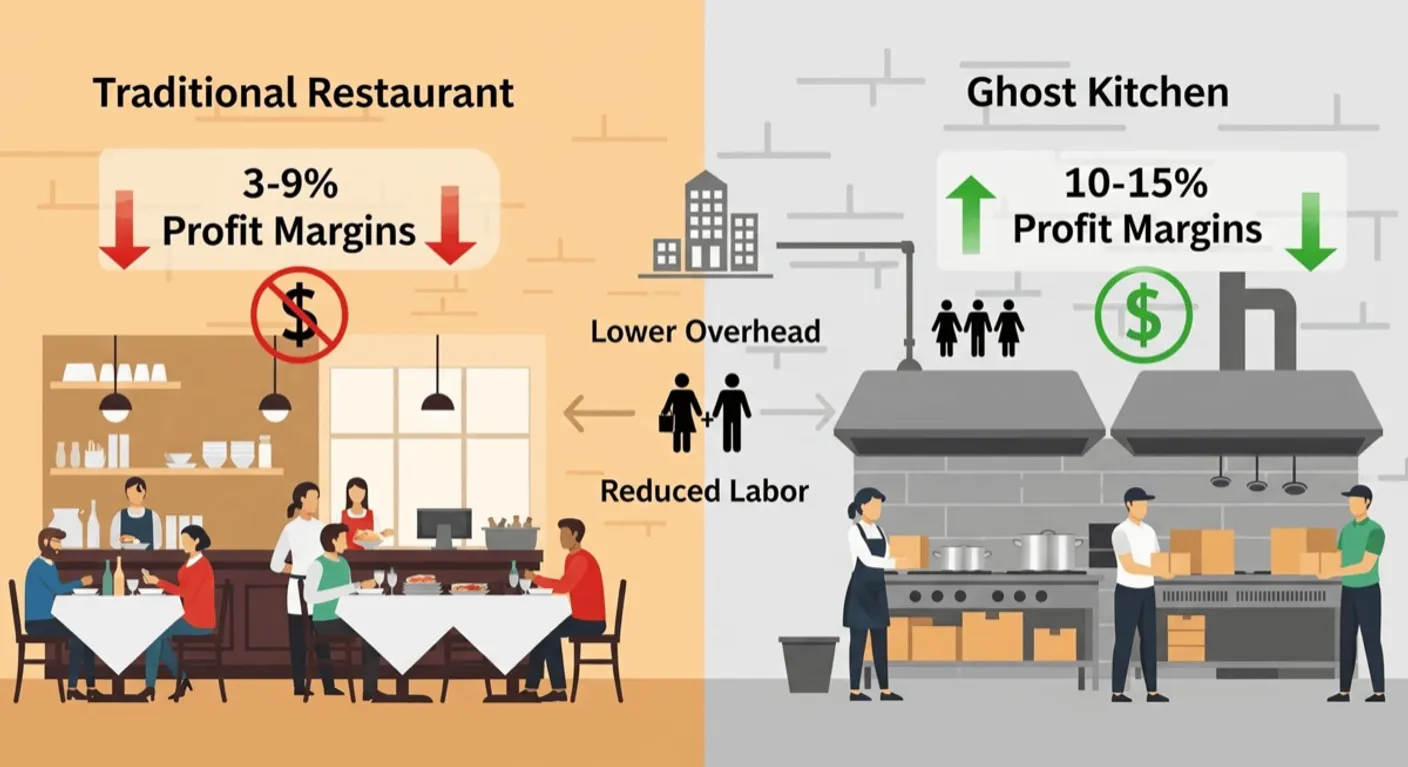
Traditional restaurants typically operate on razor-thin profit margins, somewhere between 3% and 9% if you’re lucky (and good). Ghost kitchens, on the other hand, can push profit margins into the 10% to 15% range, sometimes higher. Why? Two big reasons: lower overhead and leaner labor.
Lower overhead costs
Your biggest win with a ghost kitchen is slashing the costs that usually bleed a traditional restaurant dry. No need for a prime downtown location where rent could fund a small yacht. You can operate out of industrial areas, shared kitchen facilities, or even underutilized space in your existing restaurant.
You’re also ditching the expenses that come with a dine-in experience—tables, chairs, fancy lighting, HVAC systems that keep diners comfortable, bathrooms that need constant cleaning. Even utilities drop because you’re not heating, cooling, or lighting a massive dining area. For many operators, rent alone drops by 40% to 60% compared to a traditional spot. That’s real money staying in your pocket (or at least not flying out the door).
Reduced labor needs
Front-of-house staff? Gone. Hosts, servers, bartenders, bussers—you don’t need ’em. Your team shrinks to cooks, kitchen staff, and maybe someone managing orders and coordinating with delivery drivers. Depending on your volume and setup, you could run a ghost kitchen with half (or less) the staff you’d need for a full-service restaurant.
Labor typically eats up 25% to 35% of revenue in traditional restaurants. In a ghost kitchen, you might trim that to 20% to 25%. Every percentage point you save is a percentage point closer to profitability. And in an industry where margins are tighter than a new pair of non-slip shoes, that matters—a lot.
Key factors that determine if your ghost kitchen will profit
Not all ghost kitchens are created equal. Some operators are printing money, while others barely keep the lights on. The difference? A handful of critical factors that separate the profitable from the ghosts.
Location and demand
Yes, you’re delivery-only, but location still matters. You need high delivery demand and proximity to customers so orders arrive fresh. Too far from dense residential or office areas? Delivery times stretch, food quality suffers, and customers bounce.
Consider delivery zone overlap. Multiple neighborhoods within 15-20 minutes? Perfect. In the boonies with 40-minute deliveries? That’s a problem.
Delivery demand varies by market. Urban centers with young, tech-savvy populations? Gold mines. Suburban areas where people cook at home? Tougher sell.
Menu and food costs
Your menu is your lifeline. You need items that travel well, reheat decently (or don’t need reheating), and maintain quality during delivery. French fries? Tricky. Rice bowls? Money.
Food costs should hover around 28% to 32% of revenue. Any higher squeezes margins thin, especially with delivery fees. Smart operators design menus with overlapping ingredients to reduce waste and simplify inventory. If your wings, tacos, and sandwiches share chicken, sauces, and toppings, you’re buying in bulk and maximizing every dollar.
Platform fees
The elephant in the room: the 30% bite out of every order. Third-party platforms like Uber Eats, DoorDash, and Grubhub charge 15% to 30% commission per order. That’s a massive chunk of revenue vanishing before you count food and labor costs.
Some ghost kitchens offset this by marking up delivery prices, but there’s a ceiling—customers will only pay so much for a burrito. Others negotiate better rates with high volume or build direct ordering channels to bypass fees altogether. Without a strategy to manage these fees, profitability becomes a distant dream.
Ghost kitchens generate $15K-$50K+ monthly with 8-15% profit margins
So what can you actually expect to make? Let’s get into the weeds.
A well-run ghost kitchen can generate anywhere from $15,000 to $50,000+ per month in revenue, depending on location, concept, and execution. Multi-brand ghost kitchens—those running several virtual concepts out of one space—can push even higher, sometimes crossing six figures monthly.
Profit potential, after all expenses (including those pesky delivery fees), typically lands between 8% and 15% of revenue. On $30,000 in monthly sales, that’s $2,400 to $4,500 in profit. Not bad for a model with lower risk and investment than a traditional restaurant. But keep in mind, you need volume. A ghost kitchen is a numbers game. You’re not making $50 per table turn—you’re making $12 to $25 per delivery order. To hit meaningful profit, you need a lot of orders flowing through.
Some operators report breaking even within 3 to 6 months and hitting profitability by month 6 to 12. Compare that to traditional restaurants, which often take 18 to 24 months (or longer) to turn a profit, and the appeal becomes crystal clear.
Maximize profitability with menu optimization and fee management
Alright, enough doom and gloom. Let’s talk about how you actually win with a ghost kitchen.
Optimize your menu ruthlessly. Focus on high-margin items that travel well and share ingredients. Cut anything that doesn’t pull its weight. Every dish should earn its spot.
Negotiate or bypass delivery fees. If you’re doing serious volume, negotiate commission rates with platforms. Better yet, build your own ordering system—website, app, or even social media—and drive customers there with incentives. Cutting out the middleman can add 15% to 30% back to your bottom line.
Run multiple brands from one kitchen. If space and capacity allow, launch complementary virtual concepts. A taco brand, a wings brand, and a dessert brand can all share equipment, ingredients, and staff while targeting different customer cravings. More brands mean more visibility and more orders.
Invest in packaging and presentation. First impressions matter, even in delivery. Quality packaging protects food quality and elevates your brand. Customers remember when their meal arrives looking (and tasting) great, and they’ll order again.
Lean into data. Platforms provide treasure troves of data—order times, popular items, customer feedback, delivery performance. Use it. Adjust your menu, pricing, and hours based on what’s actually working, not what you think should work.
Market like your life depends on it. Build an email list. Run targeted social ads. Partner with local influencers. Offer first-time discounts to hook new customers, then wow them so they come back. Customer lifetime value is your lifeline.
Control what you can control. Speed, consistency, and quality are non-negotiables. A ghost kitchen lives and dies by reviews and repeat orders. One bad experience—cold food, missing items, long waits—can kill momentum. Nail the basics, every single time.
Ghost kitchens are profitable with the right strategy
So, are ghost kitchens profitable? They can be, and for many operators, they are. The model offers lower overhead, leaner operations, and the potential for healthy margins that traditional restaurants can only dream about. But profitability isn’t guaranteed. It hinges on smart location choices, ruthless menu optimization, managing delivery platform fees, and relentless focus on execution and customer experience.
If you go in with your eyes open, a solid plan, and the willingness to adapt and optimize constantly, a ghost kitchen can be a powerful revenue stream—or even a full-fledged business. But if you’re hoping it’s a set-it-and-forget-it goldmine, think again. This model rewards the disciplined, the data-driven, and the obsessively customer-focused.
Frequently Asked Questions
How much does it cost to start a ghost kitchen?
Starting a ghost kitchen typically costs $30,000 to $100,000, significantly less than traditional restaurants. Costs include kitchen equipment, initial inventory, licenses, and marketing. Shared kitchen spaces reduce startup costs further, making it accessible for first-time operators.
What are the biggest expenses that hurt ghost kitchen profitability?
Third-party delivery platform fees are the biggest profit killer, taking 15% to 30% per order. Combined with food costs around 28% to 32% and labor at 20% to 25%, these expenses significantly compress margins if not managed strategically.
Can you run multiple restaurant brands from one ghost kitchen?
Absolutely. Many operators run multiple virtual brands from a single kitchen, sharing equipment, ingredients, and staff. This strategy increases order volume, maximizes kitchen capacity, and allows you to target different customer segments simultaneously, boosting overall profitability.