Ever wondered if your pricing is leaving money on the table or driving customers away? Getting bar pricing right is tricky: too high and regulars walk out, too low and you’re running a charity with a liquor license.
Your pricing strategy isn’t just numbers on a menu—it shapes your profit margins, customer perception, and whether you’re building a thriving business or barely staying afloat.
This guide breaks down everything from pour costs and markup methods to dynamic pricing techniques that maximize revenue without alienating customers. Whether you’re pouring craft cocktails or serving cold beers, these strategies will help you find the sweet spot between profitability and customer satisfaction.
What you need to know about bar pricing basics and metrics
Before you can master the art of pricing, you need to get cozy with the numbers that actually matter. Think of this as learning to walk before you run, except in this case, you’re walking toward better profit margins.
Pour cost explained
Pour cost (sometimes called beverage cost or product cost) is the percentage of revenue that goes toward the actual cost of the drink ingredients. Calculate it by dividing the cost of goods sold by your total beverage sales, then multiply by 100. So if you spent $2,000 on inventory and made $10,000 in sales, your pour cost is 20%.
Why should you care? Because pour cost tells you whether you’re pricing effectively or bleeding money with every cocktail. Most successful bars aim for a pour cost between 18-24% for liquor, though beer and wine often run higher (25-30% isn’t unusual). If your numbers are creeping above these ranges, you’re either undercharging or over-pouring, neither of which your accountant will love.
Essential metrics to track
Pour cost is your MVP, but it’s not the only player on the field. You’ll want to keep tabs on these metrics too:
Gross profit per item tells you the actual dollar amount you’re pocketing on each sale. A $12 cocktail with a $2 product cost gives you $10 in gross profit, and that matters more than percentages when you’re paying rent.
Prime cost combines your product cost and labor. This is the reality check. You might have great pour costs, but if you’re staffing three bartenders during slow shifts, your prime cost will expose that inefficiency fast. Aim to keep prime cost below 60% of revenue.
Sales mix shows which drinks are actually moving. That fancy mezcal cocktail might have great margins, but if you only sell two per week, it’s not saving your business. Track what sells and adjust accordingly.
Don’t forget inventory turnover rate, how quickly you’re moving through stock. Slow-moving inventory ties up cash and risks spoilage. Calculate it by dividing your cost of goods sold by your average inventory value.
Core pricing strategies every bar owner should master
Now that you’ve got the fundamentals down, let’s talk strategy. There’s no one-size-fits-all approach here—your pricing needs to fit your concept, your market, and your goals like a perfectly poured Guinness settles in its glass.
Cost-plus pricing method
This is Pricing 101, and honestly? It works. Take your product cost and multiply it by your desired markup. If you’re targeting a 20% pour cost, you’d multiply your cost by 5. That $2 pour of whiskey becomes a $10 drink. Simple math, predictable margins.
Most bars use different multipliers for different categories. Liquor often gets marked up 4-5x, beer might be 3-4x, and wine by the glass typically sits around 3-4x the bottle cost divided by servings. The beauty of this method is its consistency—you can price your entire menu quickly and maintain steady margins across the board.
But here’s the catch: cost-plus doesn’t account for perceived value. Sometimes you can charge more (and sometimes you should charge less) based on what customers expect.
Gross profit pricing
Instead of focusing on percentages, this method prioritizes the actual dollars you’re making. Ask yourself: how much profit do I need per drink to cover expenses and hit my targets?
Let’s say you need an average of $8 gross profit per drink. If a cocktail costs you $3 to make, you price it at $11. A beer that costs $1.50? That’s $9.50. This approach ensures every sale contributes meaningfully to covering your fixed costs—rent, utilities, salaries, that espresso machine you had to have.
The downside? Your pricing might seem inconsistent to number-crunchers. But customers don’t usually calculate your margins (thank goodness)—they evaluate based on value and experience.
Value and competition pricing
Value-based pricing asks: what’s this drink worth to my customer? A craft cocktail made with house-infused spirits and fresh ingredients? That’s worth more than a Jack and Coke, even if the pour costs are similar. Location matters too—a rooftop bar with skyline views can command higher prices than a strip-mall spot.
Competition-based pricing means checking what similar bars charge and positioning yourself accordingly. You don’t have to match competitors dollar-for-dollar, but you need to be aware of the landscape. If every bar within three blocks charges $7 for a domestic beer and you’re at $10, you’d better have a damn good reason (craft selection, live music, superior ambiance, something).
The smartest operators blend these approaches. Use cost-plus as your baseline, adjust for value and competition, then test and refine based on customer response.
Advanced bar pricing techniques to maximize your revenue
Ready to level up? These techniques separate the amateurs from the pros, and they can seriously boost your revenue when implemented thoughtfully.
Three-tier pricing system
Psychology time: customers love choices, but too many choices paralyze them. Enter tiered pricing. Organize your offerings into good-better-best categories, and watch something magical happen—most people gravitate toward the middle option.
For spirits, this might look like well drinks ($8), call brands ($10), and premium selections ($13-15). The well option anchors the low end, making the call brands seem reasonable, while the premium tier gives status-conscious drinkers their moment to shine.
This works for beer too. Domestic standards, craft selections, and specialty or imported options create natural tiers. Bonus: the premium tier makes you look sophisticated even if most customers stick with mid-tier options.
The brilliance here isn’t just psychological—it’s operational. Tiered pricing simplifies your menu, makes bartender training easier, and gives customers clear guidance without overwhelming them with 47 different price points.
Dynamic pricing strategies
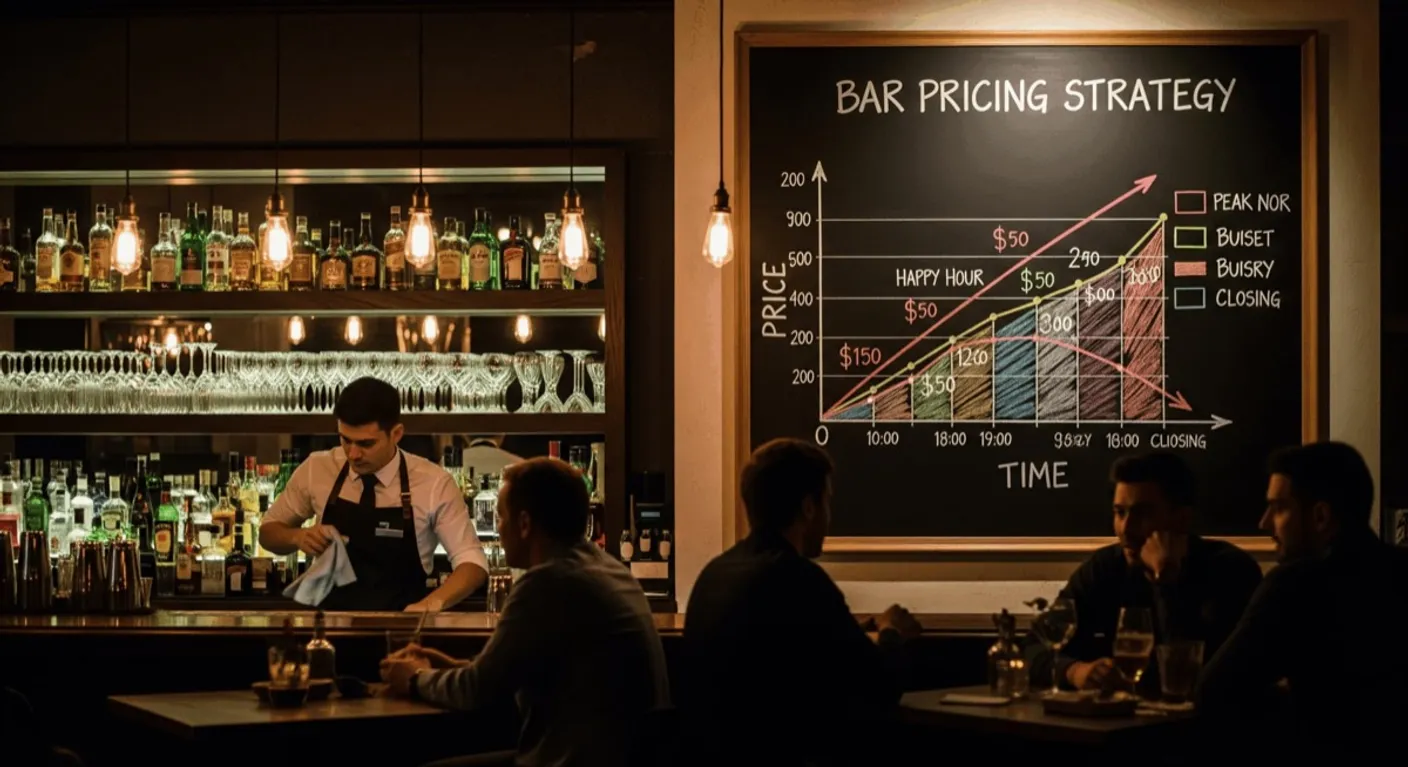
Who says your prices need to stay static? Airlines and hotels figured out dynamic pricing years ago—it’s time bars caught up. Happy hour is the most obvious application: lower prices during slow periods to drive traffic. A $5 beer from 4-6 PM becomes $7 after that. You’re essentially buying customers during your slowest hours.
But you can get creative. Weekend pricing, event-night premiums, seasonal adjustments—these all make sense. If you’re slammed every Saturday night with a line out the door, why charge the same as Tuesday at 3 PM? Controversial? Maybe. Profitable? Absolutely.
Some bars are even experimenting with real-time pricing based on demand (think stock market displays showing drink prices fluctuating). It’s gimmicky, sure, but it creates buzz and gives regulars a reason to show up early for better deals.
How to price beer, liquor, wine, and cocktails at your bar
Not all drinks are created equal, and your pricing should reflect that. Let’s break down the nuances by beverage type.
Beer pricing strategies
Draft beer offers the best margins. A standard keg yields about 115-120 usable pints after accounting for waste. At $100 per keg, that’s roughly $0.85 per pint. Apply a 3.5-4x markup for $10.50-14 retail pricing.
Bottled and canned beer typically get a 3-4x markup (a $1.50 bottle becomes $4.50-6.00), while craft and specialty beers can push 4-5x.
Pro tip: Price draft attractively to encourage volume—better margins and less inventory to manage.
Liquor and cocktail pricing
Liquor delivers your best margins with standard 1.5 oz pours: 4-5x markup for well brands, 5-6x for call, and 6-8x+ for premium.
For cocktails, calculate total ingredient cost (spirit, mixers, garnishes, ice) and multiply by 4-5x. A cocktail with $3 in ingredients should retail around $12-15. Factor in labor too—signature cocktails requiring muddling and house-made syrups warrant premium pricing beyond simple pours.
Wine pricing guide
For by-the-glass wine, aim to recoup the bottle cost in the first glass (5 oz pour), making the remaining 4 glasses profit. A $20 bottle means $20-24 per glass.
Bottle pricing typically runs 2.5-3x wholesale for standard selections ($20 bottle becomes $50-60). Premium wines can use 2-2.5x markup.
Be mindful that customers know retail wine prices. Research local stores to avoid sticker shock.
Master bar pricing to boost profits and retain customers
Here’s the truth bomb: pricing is equal parts science and art, with a splash of psychology mixed in. The bars that thrive aren’t just pouring drinks—they’re strategically pricing for profitability while delivering value that keeps customers coming back.
Start with the fundamentals (know your pour costs, track your metrics), build your strategy on solid ground (cost-plus, value-based, or competition-informed), then refine with advanced techniques that fit your concept. Remember that different beverages require different approaches, and external factors like your market and competition shape what’s actually possible.
The best part? Pricing is never finished. It’s an ongoing optimization process. As your business evolves, your market shifts, and your costs change, your pricing should adapt right alongside it. Stay curious, keep testing, and don’t be afraid to adjust when the numbers—or your gut—tell you it’s time.
Frequently Asked Questions
When should a bar increase its drink prices?
Review pricing quarterly and adjust when supplier costs rise, rent increases, or labor expenses change. Small adjustments of $0.50-1.00 typically go unnoticed. Time larger increases with menu redesigns or roll them out gradually to avoid customer backlash while maintaining profitability.
What external factors influence bar pricing decisions?
Pricing doesn’t happen in a vacuum. External factors like your target audience, local market conditions, operating costs, and competitive landscape all shape what you can realistically charge. Ignoring these factors is like trying to sail without checking the weather.
How can I implement and optimize my pricing strategy?
Implementation starts with smart menu design—remove dollar signs, place high-margin items in the upper right corner, and avoid price columns that encourage comparison shopping. Review your pricing quarterly based on costs, market conditions, and sales data. Make small price adjustments ($0.50-1.00) rather than large jumps, and test changes through specials or limited-time offerings. Use your POS data to track what sells and monitor customer feedback closely. If customers order without hesitation and you’re consistently busy, you likely have room to increase prices; if people frequently check the menu and leave, you may need to adjust downward.