So you’re diving into the fast food game, or maybe you’re already in it and looking to upgrade, expand, or just make sure you haven’t forgotten something crucial. Either way, you know the truth: a fast food restaurant lives or dies by its equipment. Miss one critical piece, and you’re looking at bottlenecks during rush hour, angry customers tapping their feet, and a kitchen crew ready to stage a mutiny.
This guide breaks down the essential fast food restaurant equipment you absolutely need to keep your operation running smoother than a fresh batch of fries. From the heavy hitters in the back of house to the front-line warriors serving customers, we’ve got you covered.
Cooking equipment for fast food: fryers, grills, and ovens
Your cooking equipment is the heart of your fast food operation, transforming raw ingredients into menu items that keep customers coming back. Skimp here, and you’ll pay for it in slow service and inconsistent quality.
Commercial fryers
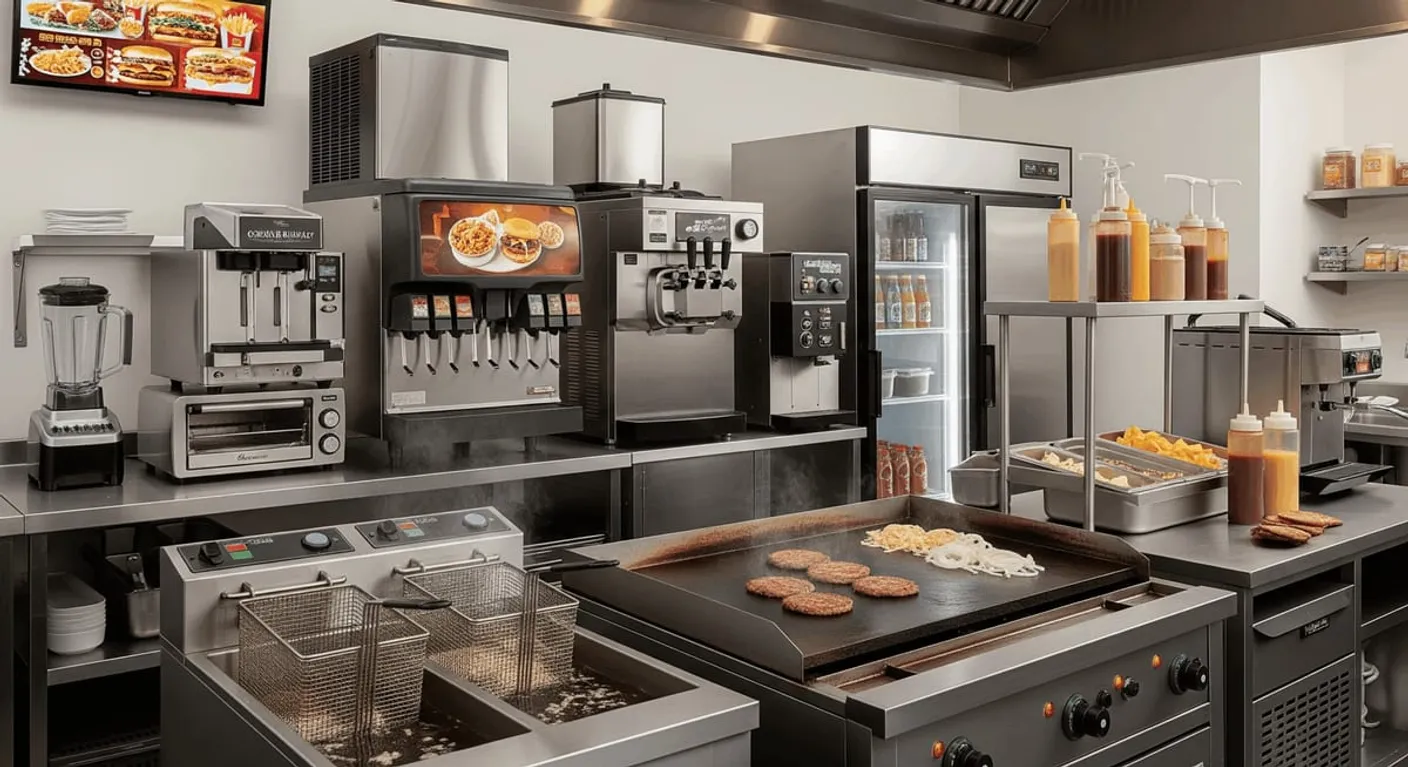
If you’re serving burgers, chicken, or anything fried, commercial fryers are non-negotiable. These heavy-duty units maintain consistent oil temperatures even when you drop in batch after batch of frozen fries or chicken tenders.
Look for fryers with quick recovery times and adequate capacity for your volume. Serving more than 100 customers during peak hours? You’ll want at least a 40-50 lb capacity fryer. Dual-basket systems let you fry different items simultaneously without flavor contamination—nobody wants onion ring–flavored apple pies.
Gas fryers heat faster and are cheaper to operate, while electric models offer more precise temperature control. Your choice depends on your utility setup and local energy costs.
Flat top grills
The flat top grill is your workhorse for burgers, breakfast items, quesadillas, and anything needing a good sear. These provide even heat distribution across a large surface, letting you cook dozens of items at once.
Commercial griddles range from 24 to 72 inches (61 to 183 cm) wide. A 36-inch (91 cm) griddle handles about 20-30 burger patties simultaneously—perfect for most operations. Thermostatic controls maintain consistent temperatures across different zones, so you can cook eggs on one side while searing burgers on the other.
Chrome griddles are easier to clean and won’t react with acidic foods, while steel griddles retain heat better and create beautiful sear marks.
Commercial ovens
Depending on your menu, you might need a conveyor pizza oven, convection oven, or both. Conveyor ovens deliver perfect consistency—set the belt speed, and every item comes out identically cooked every time.
Convection ovens circulate hot air for faster, more even cooking, handling everything from baking biscuits to finishing par-cooked chicken. Chicken-focused concept? Consider a rotisserie oven or pressure fryer for signature flavor and texture.
Don’t forget holding cabinets or warming drawers—these keep cooked food at safe temperatures without overcooking, giving you a buffer during unpredictable rushes.
Food prep equipment: tables, processors, and slicers
Prep work happens long before the first order arrives. Your prep equipment determines how efficiently you get ingredients ready for service—and in fast food, efficiency is everything.
Prep tables
Stainless steel prep tables are the foundation of any commercial kitchen—command centers where ingredients get sliced, diced, portioned, and assembled. Choose tables with undershelf storage to maximize space and keep frequently used items within reach.
Refrigerated prep tables (also called sandwich or pizza prep tables) combine workspace with refrigerated storage, keeping your most-used ingredients at the perfect temperature. Top compartments hold pans of prepped vegetables, cheeses, sauces, and proteins, while the cabinet below stores backup supplies.
Most fast food operations need at least 6-8 feet (1.8-2.4 m) of prep table space, plus one or two refrigerated prep stations near the assembly line.
Processors and slicers
Unless you’re buying everything pre-prepped (which murders your food cost), you need commercial-grade food processors and slicers. A good food processor can dice onions, shred lettuce, and chop vegetables in seconds—tasks that would take a prep cook thirty minutes by hand.
Commercial meat slicers are essential for deli-style sandwiches or thin-sliced proteins. Manual slicers work for low-volume operations, but automatic slicers with adjustable thickness controls are worth the investment for high volume.
Don’t forget smaller prep tools: commercial-grade can openers, portion scoops for consistency, and color-coded cutting boards to prevent cross-contamination.
Refrigeration: walk-ins, reach-ins, and freezers
Refrigeration failures rank among the worst restaurant nightmares. Your system must be robust, reliable, and properly sized for your volume and menu.
Walk-in coolers
Beyond small food trucks, walk-in coolers are essential storage hubs for bulk produce, prepped ingredients, and backup inventory. Fast food restaurants typically need at least an 8′ x 10′ (2.4 x 3 m) cooler, with larger operations requiring double that.
Walk-in freezers are equally critical for frozen proteins, fries, and pre-made items. Invest in shelving units and label everything meticulously to avoid staff digging through boxes during rushes.
Modern walk-ins include digital temperature monitoring and alarms that alert you before temperatures reach the danger zone—potentially saving thousands in spoiled inventory.
Reach-in refrigerators
Reach-in units are positioned at cooking stations so staff can grab ingredients without leaving their posts. A two or three-door reach-in provides 49-72 cubic feet of storage, sufficient for most fast food kitchens.
Glass-door models reduce temperature fluctuations by letting you see contents without opening, while solid-door unitsare more energy-efficient. Under-counter refrigeration drawers maximize space beneath cooking equipment.
Plan for at least one reach-in refrigerator section per cooking station, plus additional freezer sections for frequently accessed items.
Front of house equipment: POS, displays, and holding units
Front-of-house equipment is where you win or lose customers. It needs to deliver fast, accurate service while maintaining the customer experience.
Point of sale systems
Your POS system is your restaurant’s central nervous system. Modern systems track inventory, monitor sales trends, manage schedules, integrate with delivery platforms, and provide data on your best and worst sellers.
Look for systems specifically designed for fast food operations with features like:
- Customizable menu layouts that match your kitchen workflow
- Kitchen display systems (KDS) that replace printed tickets and reduce errors
- Split check and modification capabilities
- Integration with loyalty programs and mobile ordering
- Offline mode (because Wi-Fi outages happen at the worst times)
Budget $1,500-3,000 per terminal plus monthly software fees. A good POS pays for itself by reducing errors and speeding up transactions.
Food holding equipment
Heat lamps, warming drawers, and display cases keep finished products at safe temperatures while maintaining quality. French fry dumps keep fries crispy, and heated display cases work well for grab-and-go setups.
For self-service setups, sneeze guards and display refrigerators let customers see options while meeting required food safety standards.
Beverage stations: ice machines, dispensers, and coffee
Beverages carry high profit margins, so don’t overlook this category. At minimum, you need a commercial ice machine(1.5 lbs per customer in summer), beverage dispenser system, and syrup storage.
Ice machines range from 400 lbs per day for small operations to 600-1,000 lbs for higher-volume restaurants. Choose between modular units (ice maker on storage bin) or self-contained units.
For coffee service, invest in commercial-grade makers or espresso machines based on your concept. Drip makers with dual or triple warmers offer regular and decaf options, while cold brew systems deliver excellent margins.
Round out your setup with cup dispensers, lid organizers, straw holders, and condiment stations to keep your counter organized and traffic flowing.
Cleaning equipment: dishwashers, sinks, and sanitation
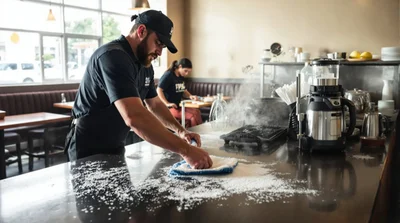
Proper sanitation equipment is required by health codes and essential for keeping your doors open. You’ll spend almost as much time cleaning as cooking.
Commercial dishwashers
Commercial dishwashers complete full cycles in 1-3 minutes using extremely hot water (150-180°F or 66-82°C) to sanitize plates, utensils, and prep containers.
Low-temp dishwashers use chemical sanitizers and cooler water, making them cheaper to operate. High-temp modelsuse hotter water and steam with no chemical residue. For most fast food operations, an under-counter dishwasherhandles the load unless you have significant dine-in traffic.
Conveyor dishwashers are for high-volume operations processing hundreds of dish racks daily.
Three-compartment sinks
Three-compartment sinks are required by health codes for manual dishwashing and large equipment cleaning. The process: wash in the first sink, rinse in the second, sanitize in the third. Each compartment must be at least 18″ x 18″ x 12″ deep (46 x 46 x 30 cm), though requirements vary by jurisdiction.
You’ll also need at least one large prep sink for washing produce and food prep tasks. Some jurisdictions require a separate mop sink—check your local codes before finalizing your kitchen layout.
Smallwares and accessories: the finishing touches
Smallwares are the essential tools and supplies you don’t think about until you need them.
Stock up on: cutting boards (color-coded for safety), knife sets with sharpener, spatulas, tongs, ladles, whisks, mixing bowls, sheet pans, hotel pans, and covers.
Keep instant-read probe thermometers for internal temperatures and infrared thermometers for surfaces—health inspectors love seeing these in use.
Other essentials: kitchen timers, oven mitts and towels (buy extra), storage containers with lids, squeeze bottles, portion scoops, measuring cups and spoons, and a first-aid kit.
Create an inventory checklist and reorder before you run out—nothing’s worse than running short on busy nights.
Your fast food equipment checklist: invest smart, maintain well
Equipping a fast food restaurant isn’t cheap—expect to invest anywhere from $50,000 to $200,000+ depending on your concept, size, and whether you’re buying new or used equipment. But here’s the thing: the right equipment isn’t an expense, it’s an investment in your operation’s efficiency, consistency, and longevity.
Start with the essentials we’ve covered: cooking equipment, prep stations, refrigeration, POS systems, and sanitation equipment. These are your non-negotiables, the foundation everything else builds on. As you grow and identify bottlenecks in your operation, you can add specialized equipment that addresses your specific needs.
And remember: your equipment is only as good as your maintenance program. Schedule regular cleaning and professional maintenance for all major equipment. An ounce of prevention beats the hell out of replacing a fryer mid-service because nobody changed the oil properly.
Frequently Asked Questions
What are 20 kitchen tools?
The 20 common kitchen tools are: chef’s knife, paring knife, cutting board, measuring cups, measuring spoons, mixing bowls, wooden spoon, spatula, whisk, tongs, peeler, grater, colander, can opener, ladle, baking sheet, skillet, saucepan, rolling pin, and kitchen shears.
What is the most common tool in a commercial kitchen?
The most common tool in a commercial kitchen is the chef’s knife. Chefs and kitchen staff use it for everything from chopping vegetables to slicing meat.